The Restructuring – Part 3 – Done!!!

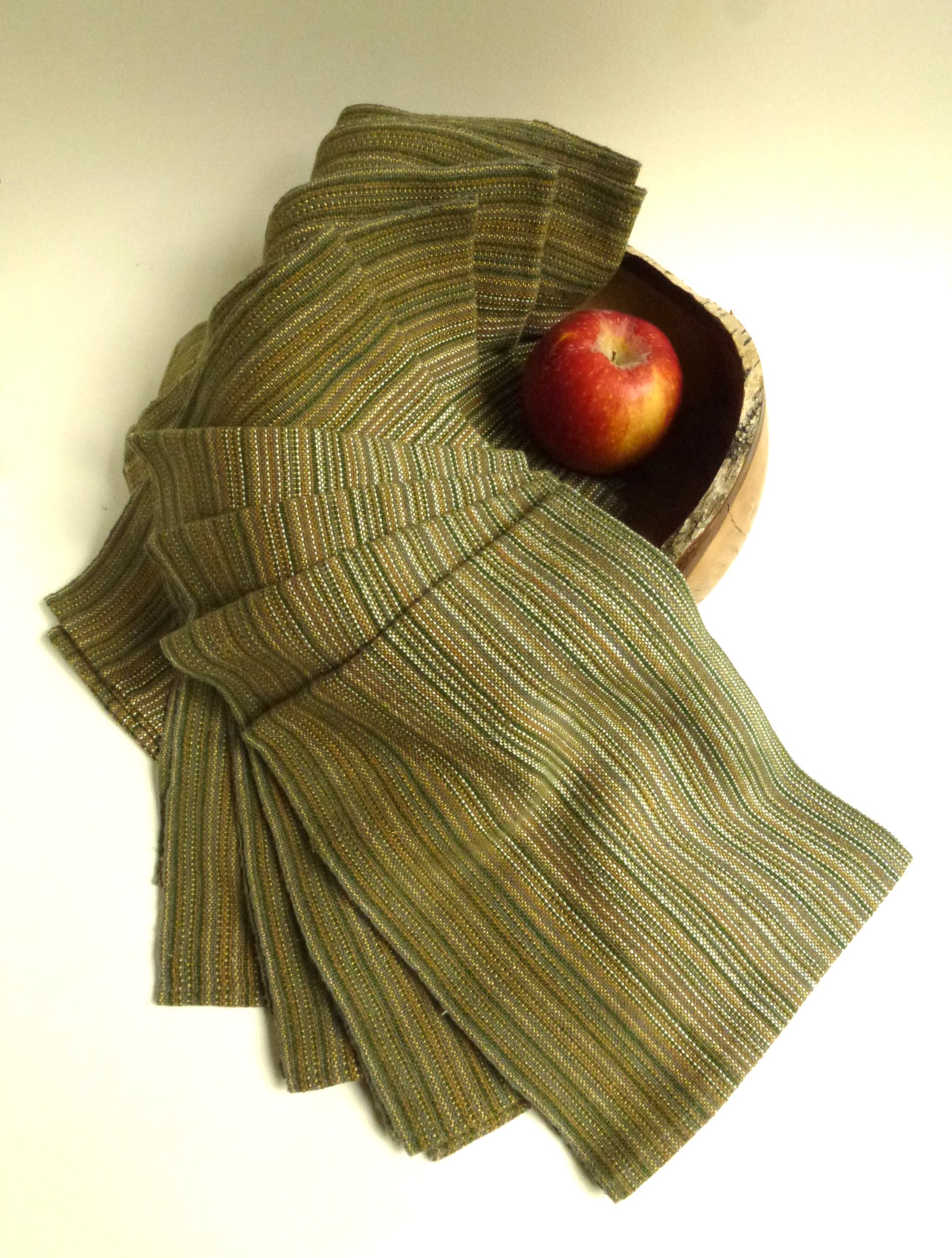
Hard to believe that this project was finished about 6 years ago! There is still one thing left to do. I have 8 dishtowels from the end of the warp that need to go out into the world and hopefully raise some money for a good cause, a group that is working for a more just and sustainable world. Let’s spread some wealth!
Recap:
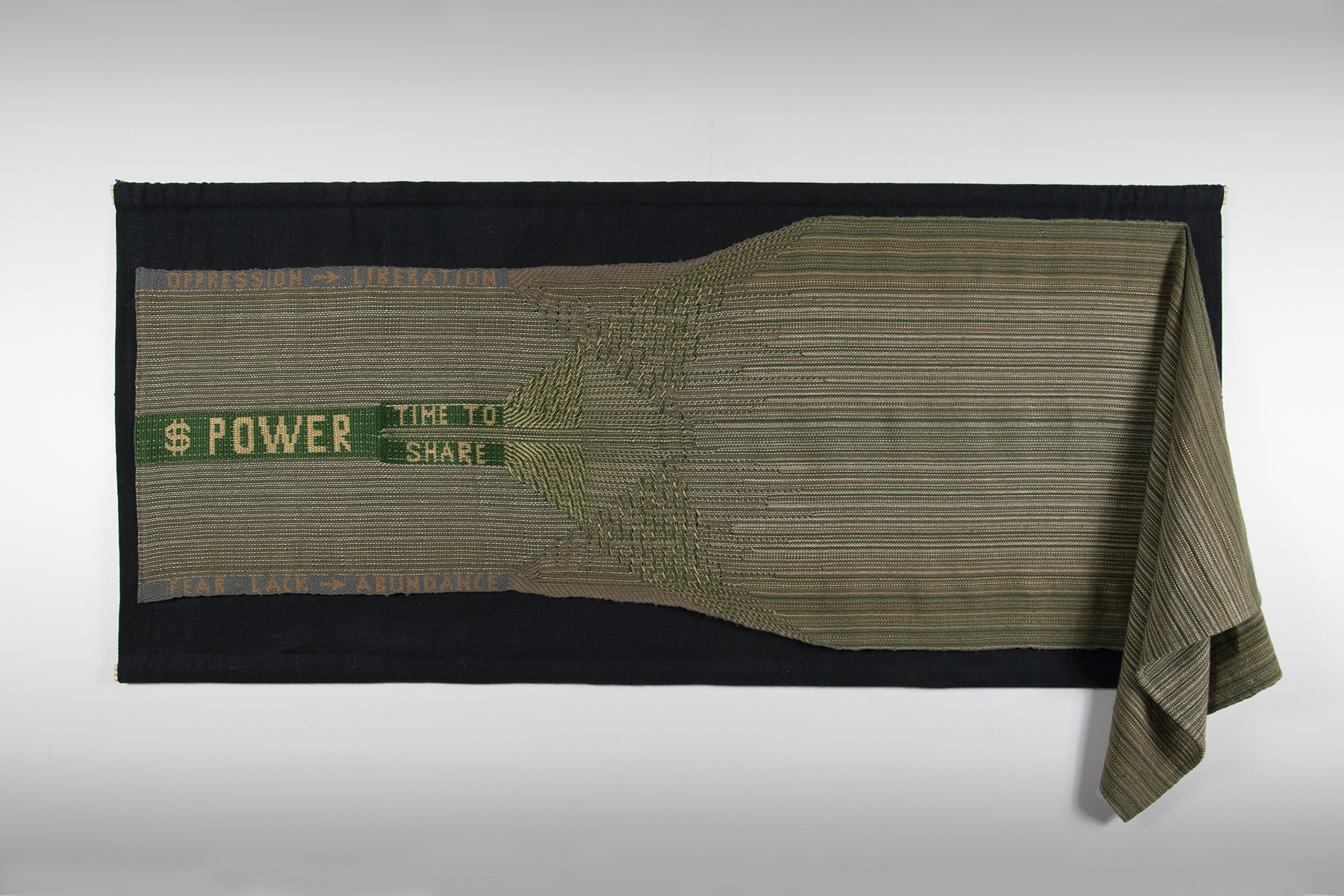
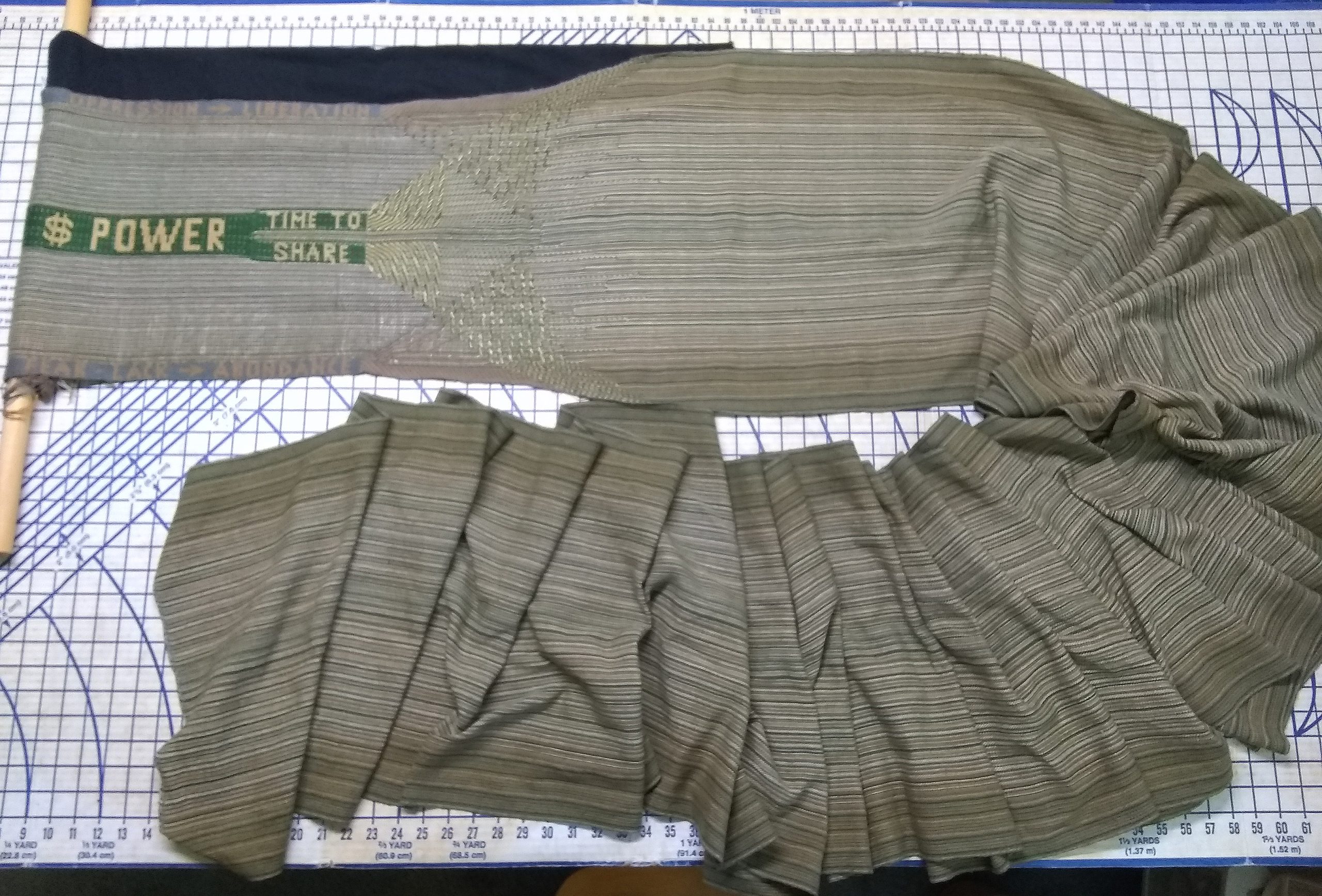
This cloth was woven during the Stay at Home order between the end of March 2020 and the weaving was finished and taken off the loom on Juneteenth (6/19/20). The idea behind this piece was to find a way to restructure the fabric of society while maintaining the parts that do work.

It is time to weave a new cloth.
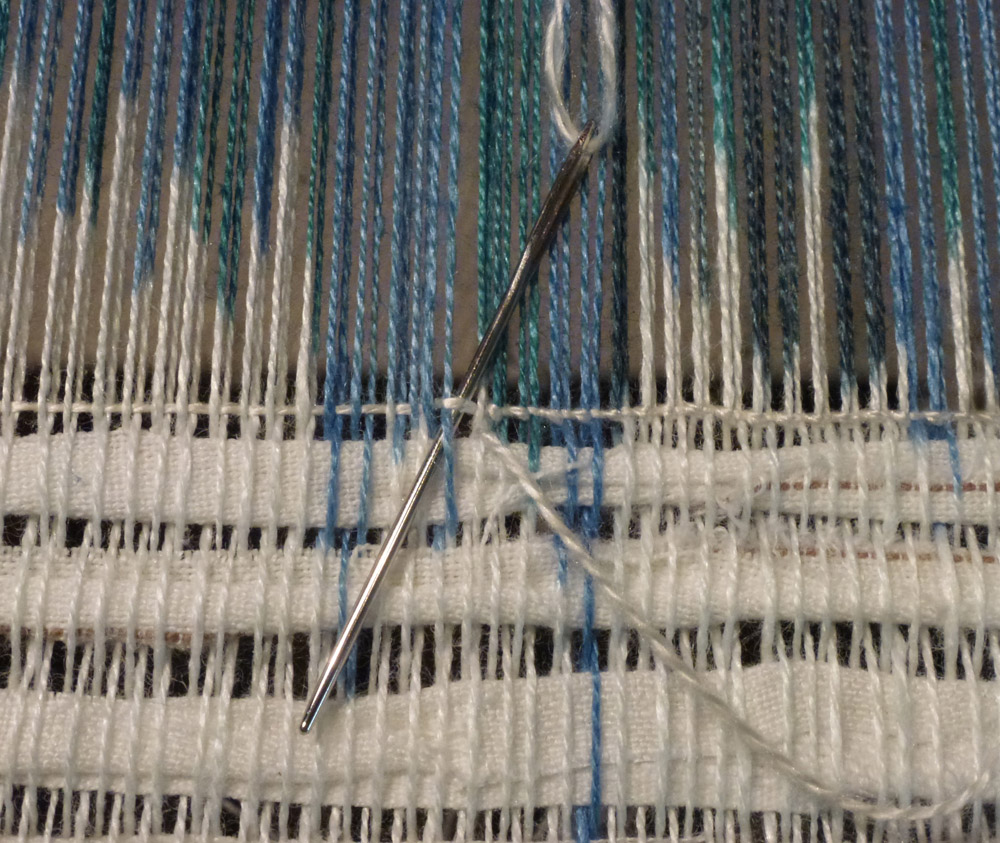
The beginning part of the cloth has a sparse background with 3 tablet woven bands representing the current state of society. The center band represents the concentrated money and power. The top band says “OPPRESSION” ➔ “LIBERATION”. The bottom band says “FEAR – LACK” ➔ “ABUNDANCE”. Those two bands represent the people who have been marginalized. Over the course of several weeks, the underlying foundation of the cloth (the warp) was restructured. The warp threads from the 3 bands were moved across the weaving with the result that the ‘Money and Power’ threads have been redistributed throughout, and the outer band warps have also spread out. The process of shifting the warp threads was really challenging and created some interesting and unexpected texture. The process and textures got even more complex when the outer warp threads moving towards the center met the inner warp threads moving out. Made me think about how do we spread out the wealth in society, as well as how we re-integrate people who have been marginalized. What happens when those two movements intersect?

Inspiration
The Covid-19 pandemic clearly showed, to anyone paying attention, the many things in our human world that do not work. It is also showed us how we are all connected. Wealth and power are concentrated in the hands of the few. Huge numbers of people, especially people of color and folks who don’t fit the dominant culture’s norms, have been marginalized. The result is a threadbare society where it is far too easy for people to fall through the cracks. This fabric is not very functional or sustainable.

The goal is to transition from a non-functional cloth to a sturdy functional cloth, to represent the society we want to create. I wove off the rest of warp and turned it into dishtowels.

Being a firm believer that things happen in ‘right timing’, the delay in getting these towels and story out in the world allows it to coincide with the current political climate. There are people in power who are working to maintain these disparities and while it is important to resist these forces, it is equally, if not more, important to illustrate the world we want to build. I will update this post when I know where the towels are going.

For those interested in the weaving geekery, here’s a summary of the process and timeline.
And for those interested in the esoteric aspects and correspondences, scroll to the end.

March 22, 2020 ordered yarn.
Prior to getting the warp on the loom, I wove a couple of sample bands and then had to get the loom set up.

April 6th, I started weaving.
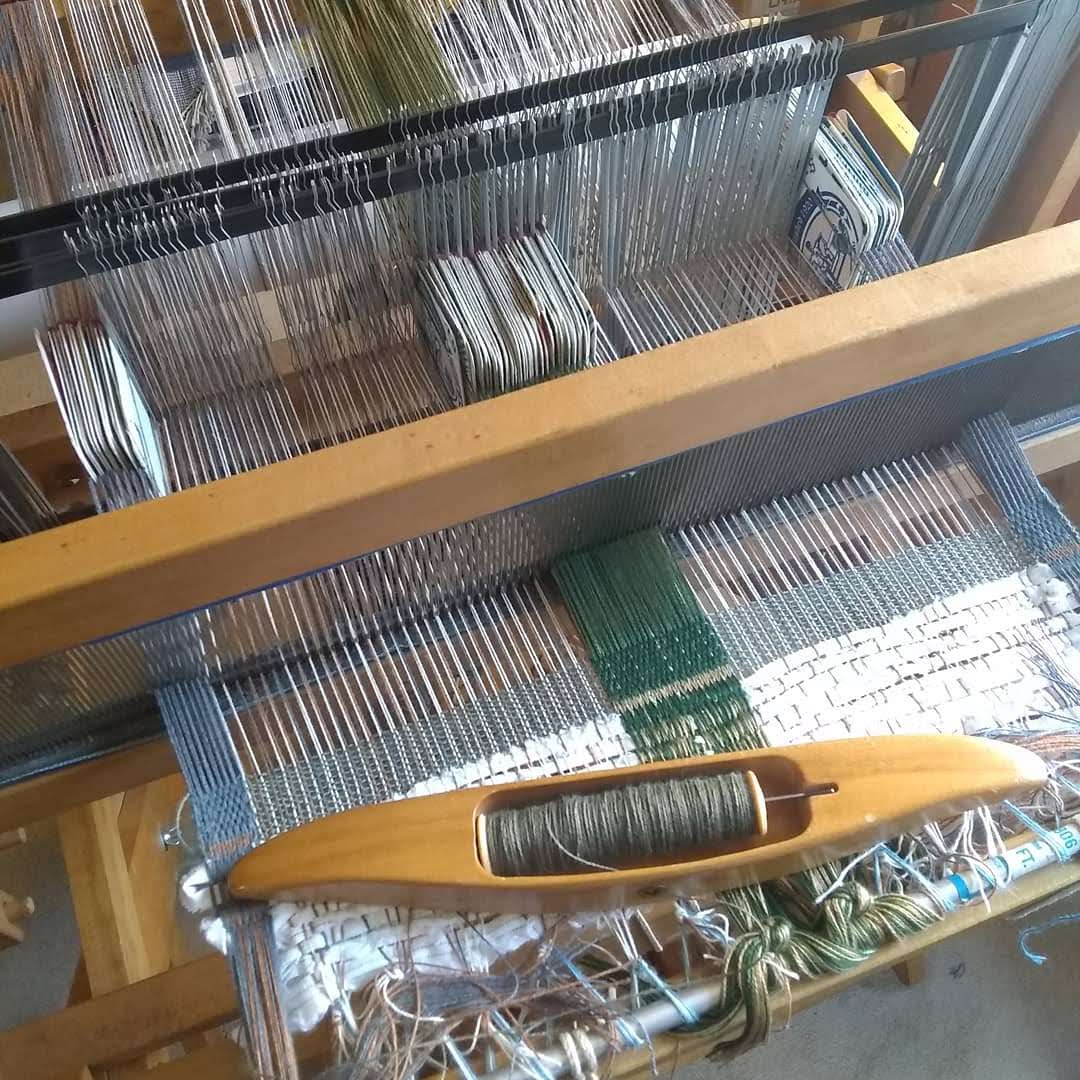
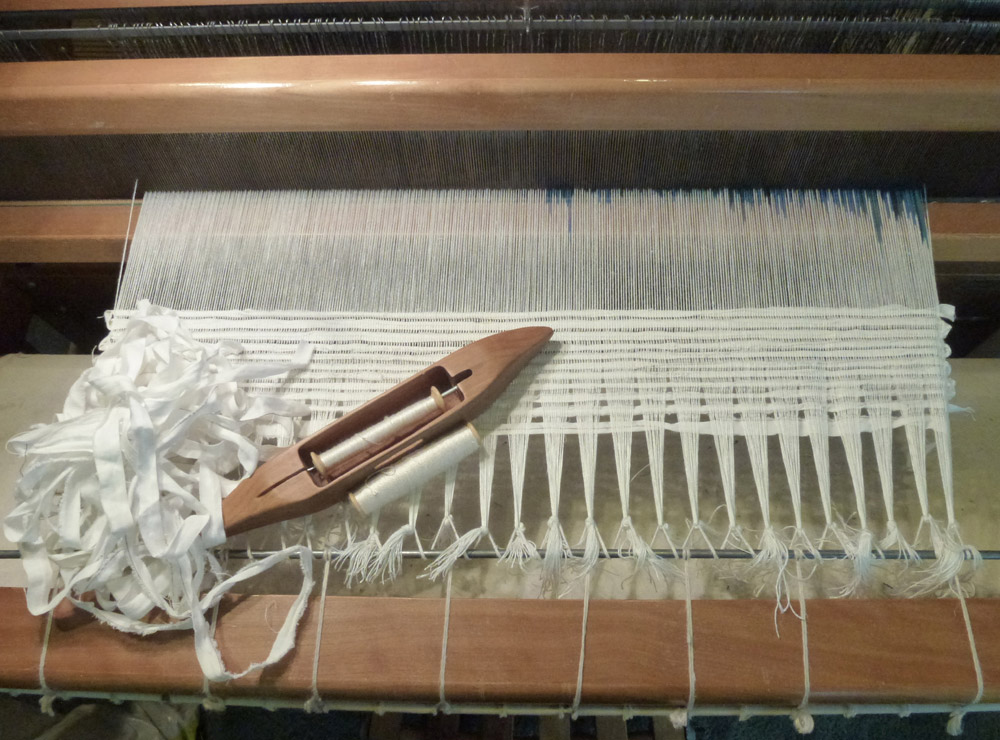
This photo shows the beginning of the weaving with the loom set up and the tablets/cards for the bands in place. If you look closely at the fabric between the bands, you can see how loosely woven it is. There are 10 threads per inch in the warp at this point.

(see 1st blog post from May 4, 2020, The Restructuring – Part 1, for more detailed info on the setup and sample bands)
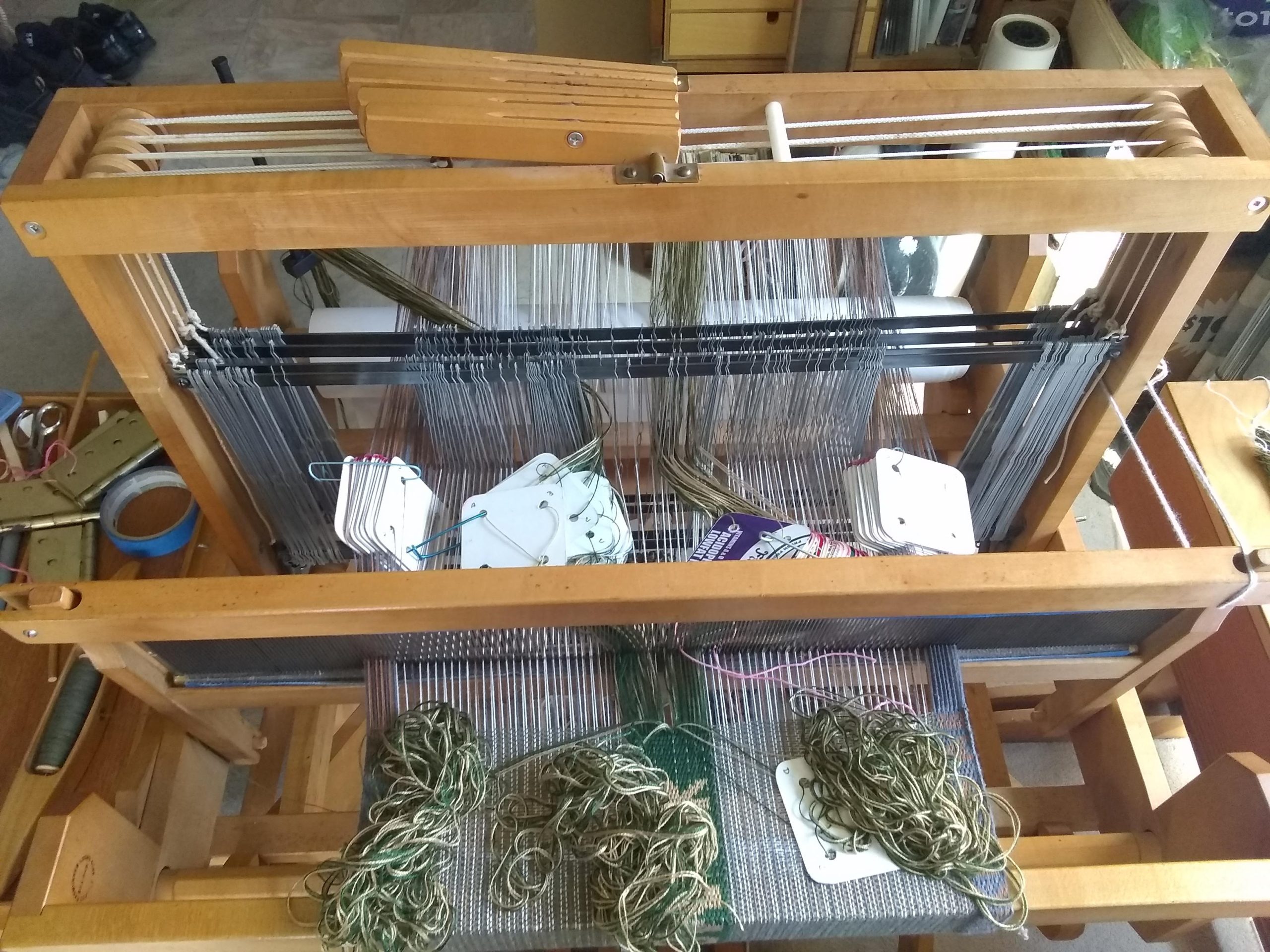
On April 10, started splitting the center band. This involved taking the weights off the warp at the back of the loom, pulling the tablets and their warp threads through the reed, moving them over and putting them back in place in the correct order as well as moving the warp threads between the heddles. And finally tying the weights back on.
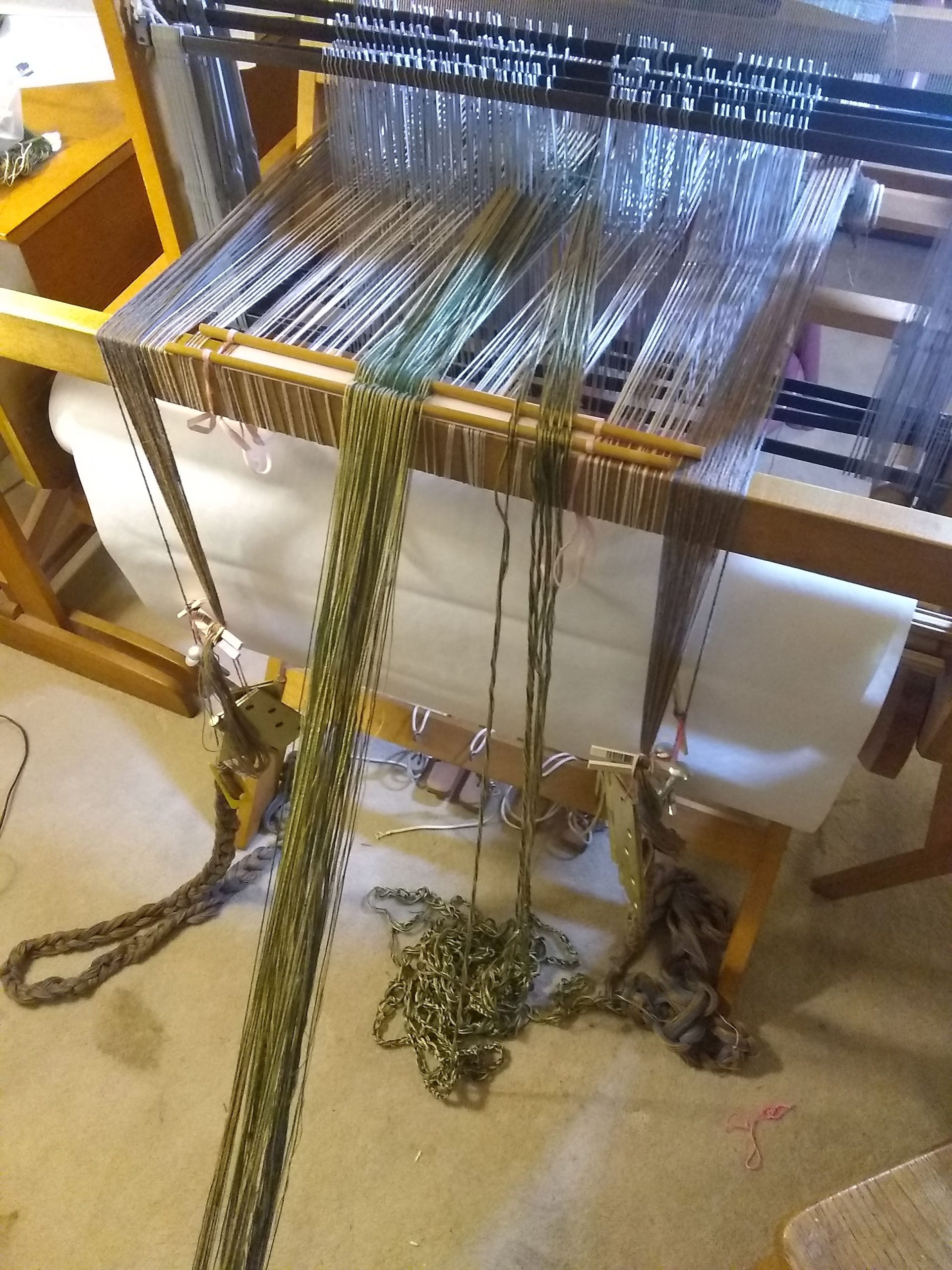
This photo shows what things looked like behind the loom. The warps for the bands were weighted while weaving.

It took about 3 days to get all those tablets and warp threads moved.
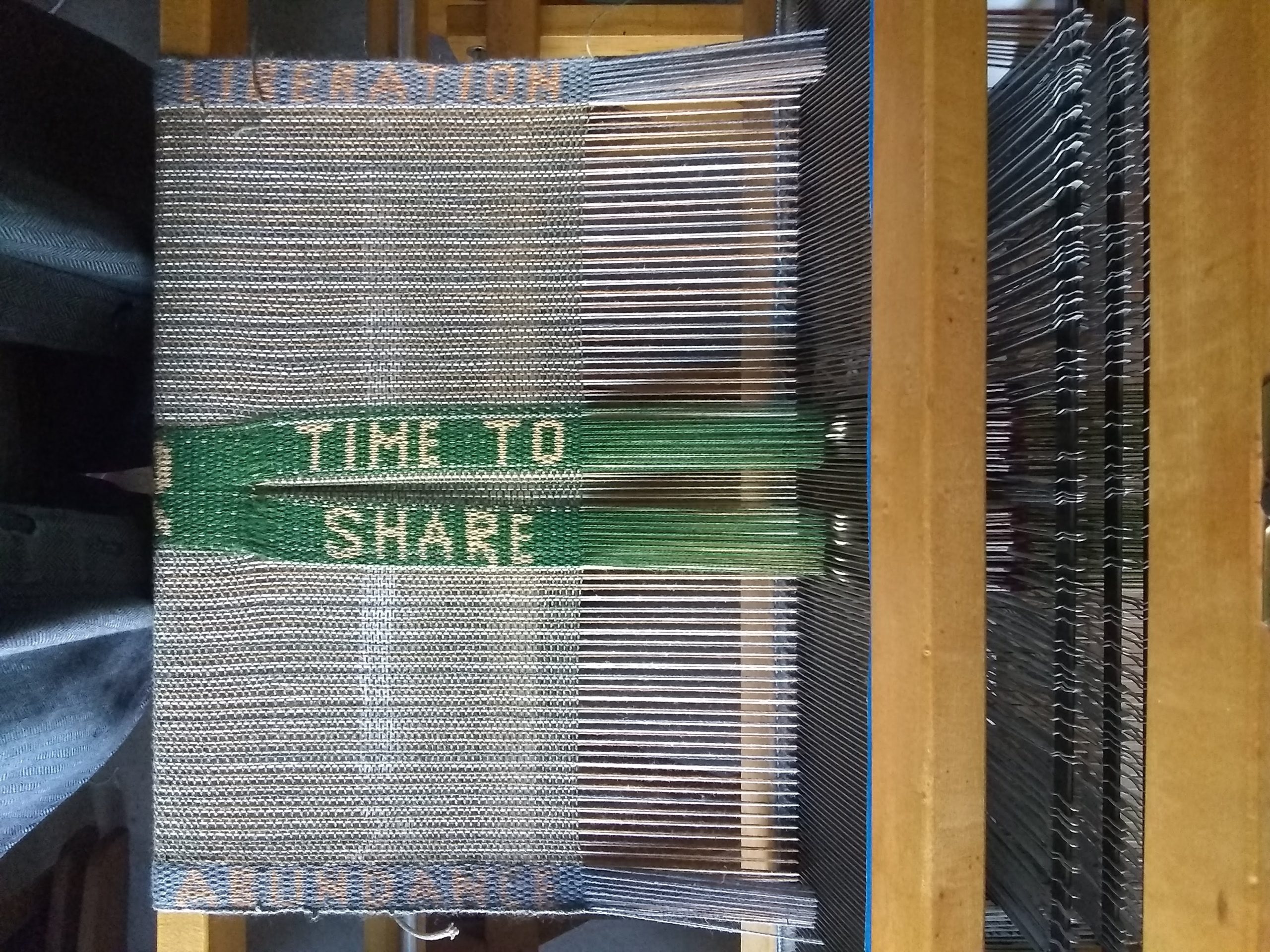
Wove “Time to Share on 4/13.
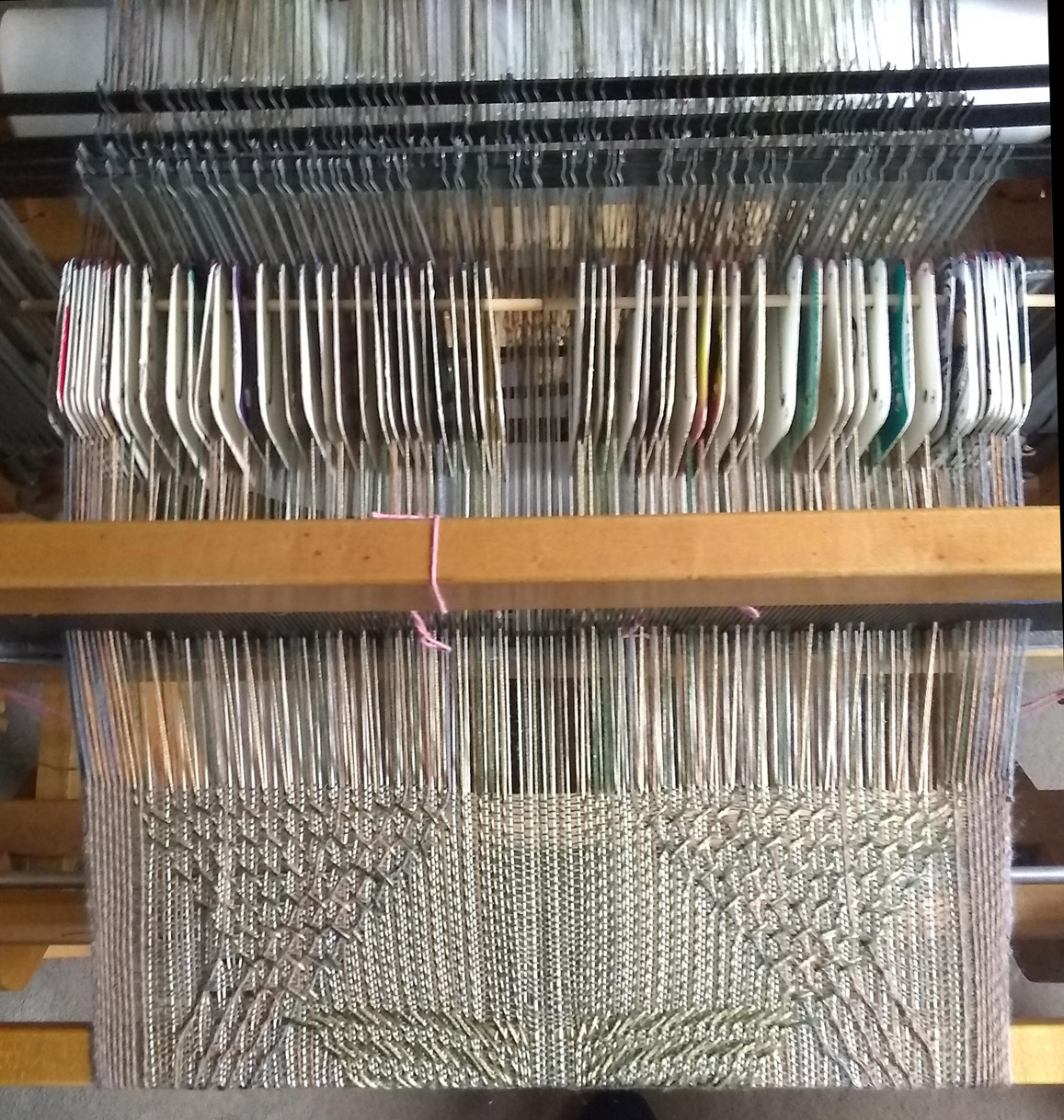
April 27 – 28, have moved the tablets 14 times.

Each tablet was moved 4 spaces in the reed at a time until it reached it’s final location.
Typically one days weaving would be to move the tablets and then weave 8 picks. Occasionally I would move the warps twice, weaving 8 picks after each move. I started the process of moving the tablets on April 14.
On May 12, I started removing the tablets and threading those warp threads into the empty heddles I had left when setting up the loom.

(For more details on moving the tablets, see the blog post from May 13 – The Restructuring – Part 2)
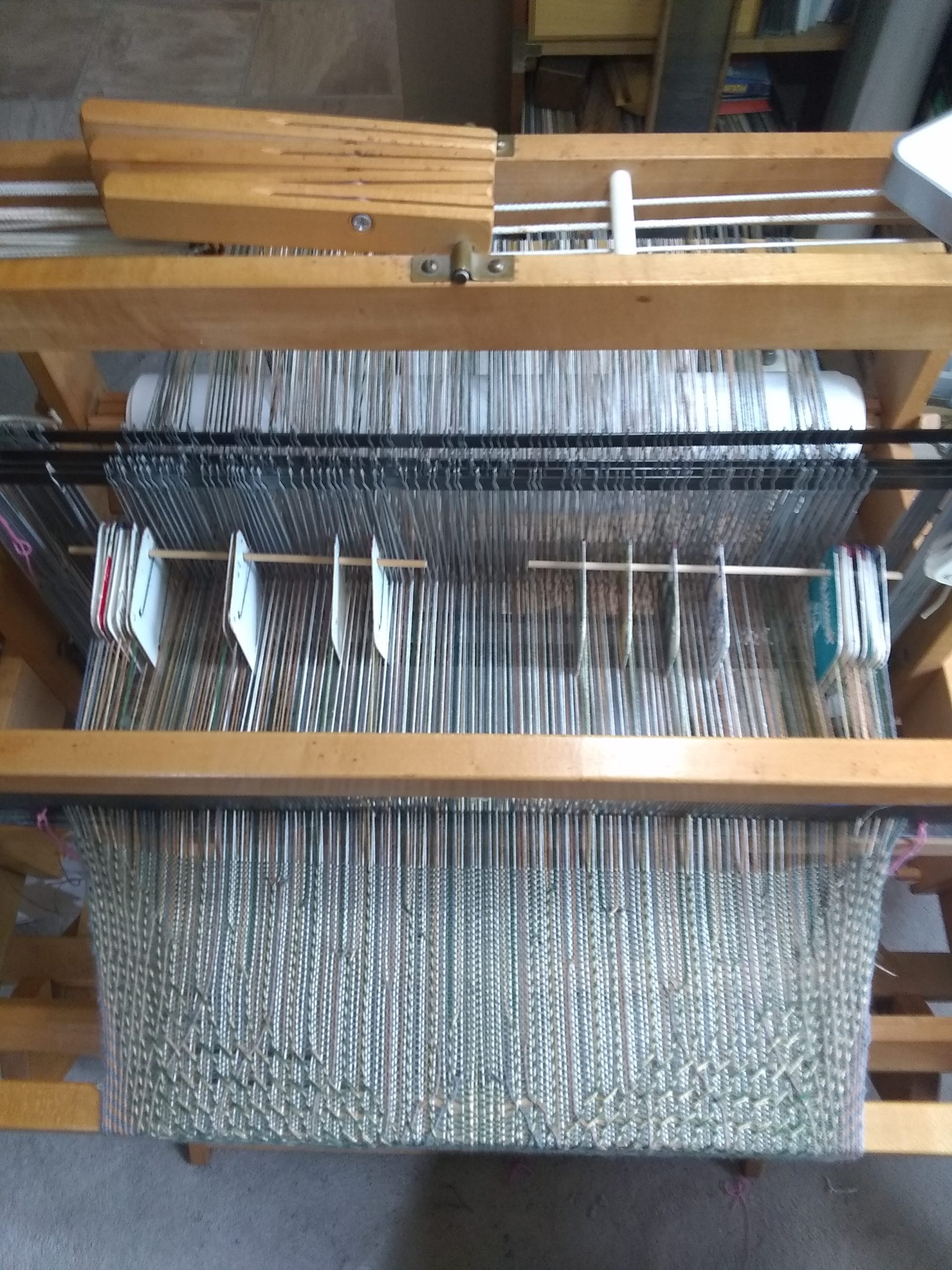
Photo taken: 5/24/20

On May 28th, I removed the last of the tablets.

On May 31, I reset the warp weights and made a couple of modifications, and started weaving the cloth to be made into towels.
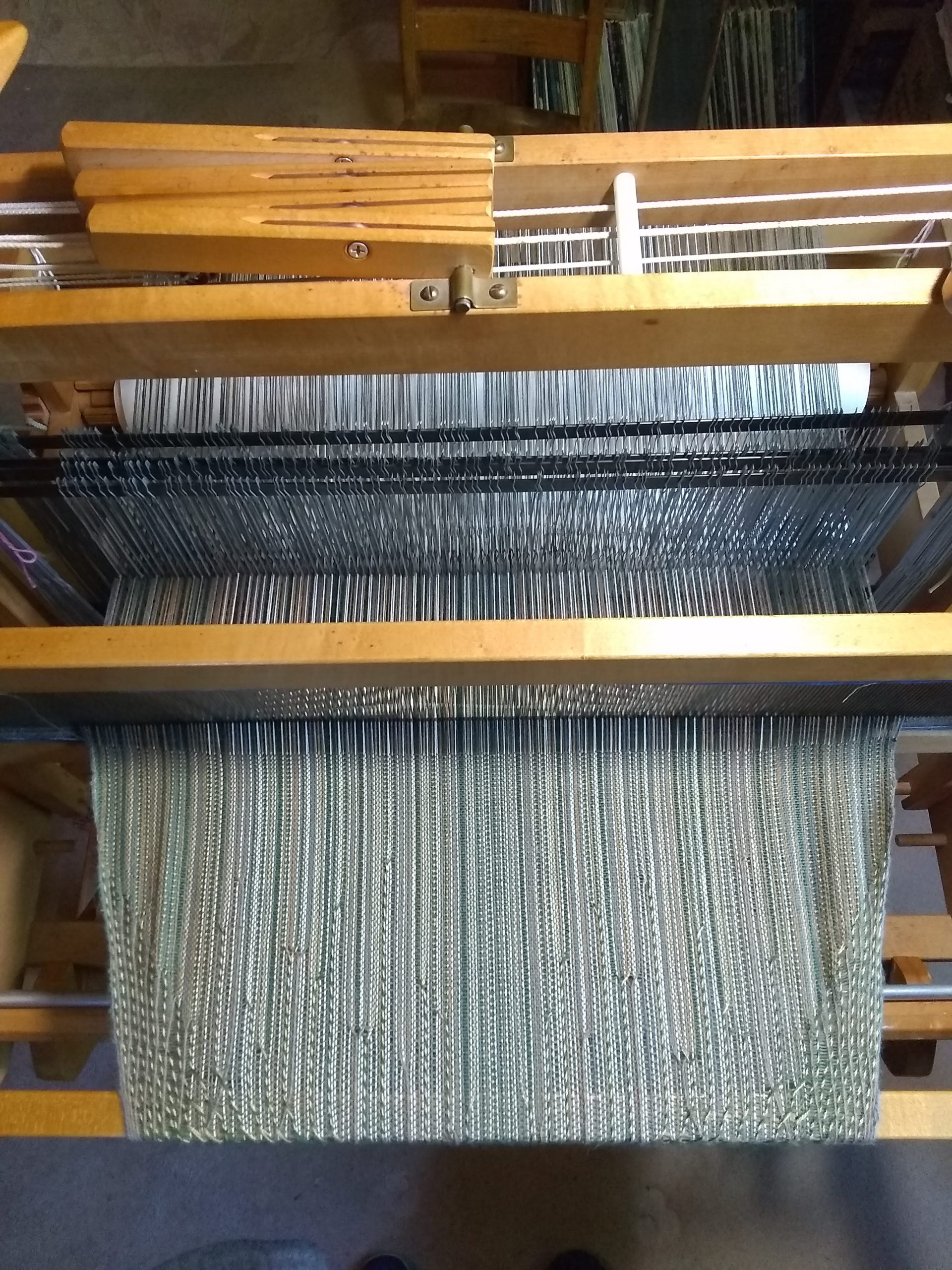
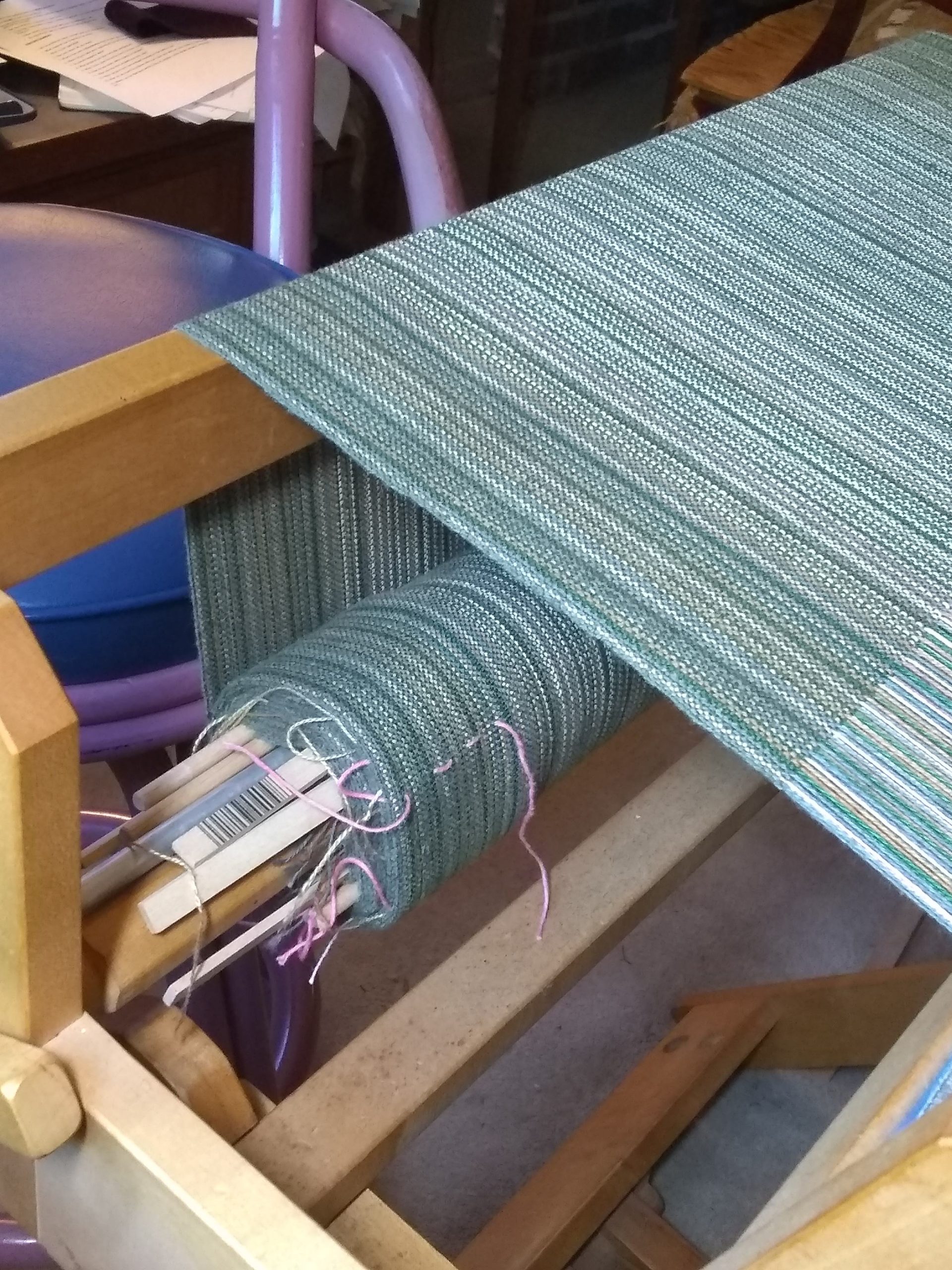
Left photo taken 6/1, all the tablets have been removed and starting to weave the towels. Right photo taken 6/17, Woven fabric wound onto the front of the loom, almost done, pink threads are length markers.

Finished weaving the rest of the warp and took it off the loom on 6/19
And for those interested in the esoteric:

Correspondences for this piece fell into 2 categories: planned symbolic representations and
numerous events that lined up while working on this piece.

Symbolism and Numbers
5 colors of warp – 80 ends each = 400 ends
Four is the number of sides of a square and is associated with stability and foundations.
160 Dark green and Yellow/gold – 8/2 tencel – shiny – Represents wealth / money / power
240 total, Gray, tan, cotton/linen yarn and white cotton yarn – represent humanity
Weft – olive green cotton/linen yarn – represents life / earth / spirit – connects everyone
10 dent reed – beginning background cloth 10 warp threads per inch, when restructuring done, it will be 20 warp threads per inch.
The background cloth at the beginning is ‘threadbare’ having half of the number of threads it should have.

Once I started moving the tablets across the warp, I wove 8 turns (of the tablets) and 8 weft picks between moves: 8 is a double square – foundation
Those 8 turns/picks became the process of building a new foundation. The first 4 was building it, the 2nd four was securing that new foundation.

Synchronicities:
Start at beginning of lockdown / stay at home order
This gave me the opportunity and time to concentrate on working on this piece.

Finished the first part (set up and wove to $ POW) just before the beginning of Passover and the 1st seder. Finished weaving the ER the next day and started the process of splitting the center band.
One of the main themes in the story of Passover is escaping from the narrow place (Mitzraim/Egypt)
As the Jewish people are leaving Egypt, they come to the Red Sea and divine intervention causes the sea to split so they can escape.
– During the first 3-4 days of Passover, I divided and moved the center cards into 2 groups. On April 13th I wove: TIME TO SHARE – This was the 4th day of Omer, and the spiritual qualities for the day are Netzach she’be Chesed – Victory / Determination within Loving Kindness.

Counting the Omer is based on an ancient agricultural practice of counting a measure (omer) of grain that was brought to the Temple in Jerusalem every day for 7 weeks (49 days). The medieval Kabbalists added the practice of associating each day with a pairing of the sefirot (spheres) on the tree of life.
– moving cards almost every day (except on Shabbat)
– started moving the cards at the start of the Omer
– finished removing the last cards on day 49 of the Omer (5/28)
– This ‘restructuring’ took 7 weeks
– became my 2nd Omer project that I was working on that year
– dealing with tangling threads required a slow & gentle touch, coaxing them into place.
Right around Shavuot (Jewish holiday celebrating the receiving of the Torah which was on 5/29 that year) the protests started happening, which made this project feel even more relevant.

This is probably the most intense piece I’ve ever done / worked on. As the world is unraveling I am slowly changing the the structure of this cloth. One tablet at a time, I pull the warp threads & tablet out of the reed, move them over 4 spaces and them pull them back into their new space, over and over again. Once the group of cards are in there new locations, the warps need to be re-weighted and the tables aligned with the base warp. Everything has to be order to be able to get a clear shed. I weave 8 pics then start the moving process again.
Weaving Tallit

Some projects just have their own timetable. Apparently, this is one of them.

April 2017 – Loom set up since October 2016.

I wanted to weave more painted warp tallit, so I ordered linen yarn for the warp. That was in May of 2014.

Finally got started at the beginning of Oct. last year (2016). Wound the warp, dyed it and got it on the loom in about 2 weeks. My goal was to have at least one woven by the Seattle Weavers’ Guild sale at the end of the month. With barely a week before the sale, I realized it wasn’t going to happen, and if I tried, it would be rushed, and I wouldn’t enjoy the process. Totally not the right energy to be putting into a piece of sacred cloth.

Life happened, so it wasn’t until the beginning of April that I started weaving – Yay! Finished weaving in the header and discovered that the tension on the warp was uneven. Not good, especially with a linen warp since linen has virtually no stretch. Discovered that at the end of the warp, there wasn’t any packing on the warp beam. So, un-wove everything, un-lashed the warp, re-rolled the last yard or so, re-tied on, and got it back to the same point it was when I started that evening. More ‘Life Happening’, and so it sat again.

June 2017 – Loom set up after adjusting the warp tension in April. Ready to start again.

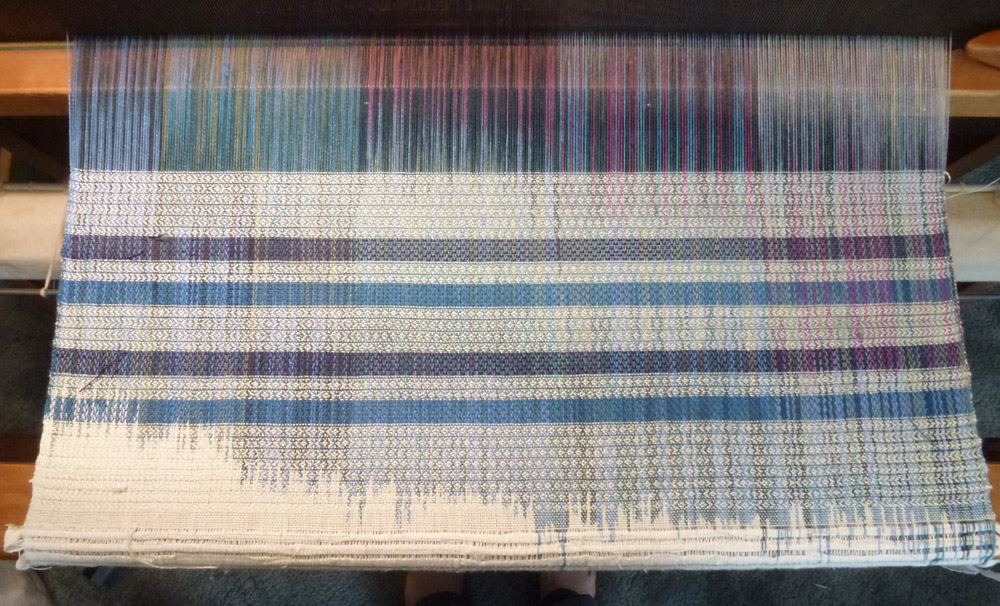
Last night, I started weaving! So, to keep this project moving along, I’m going to post progress pictures of the day’s weaving as I go along. I’ll post them on my Facebook page, and then do a weekly summary on this blog. Hope you enjoy watching the progress. So here we go!To secure the end of the weaving, I do a type of hemstitching. It essentially creates a row of twining at the beginning so it won’t unravel. Using a long tail of the weft, you go over one warp thread and then diagonally under the next one locking the weft yarn in place.First 10 inches of weaving done. Warp is a 20/2 linen sett at 24 epi. Piece is 27” wide, so there are 648 warp ends. The main weft is a 20/2 silk yarn. The blue and purple are 8/2 Tencel. Note: before doing the hemstitching, wove in more header to the beginning of the dyed part of the warp (no photo).
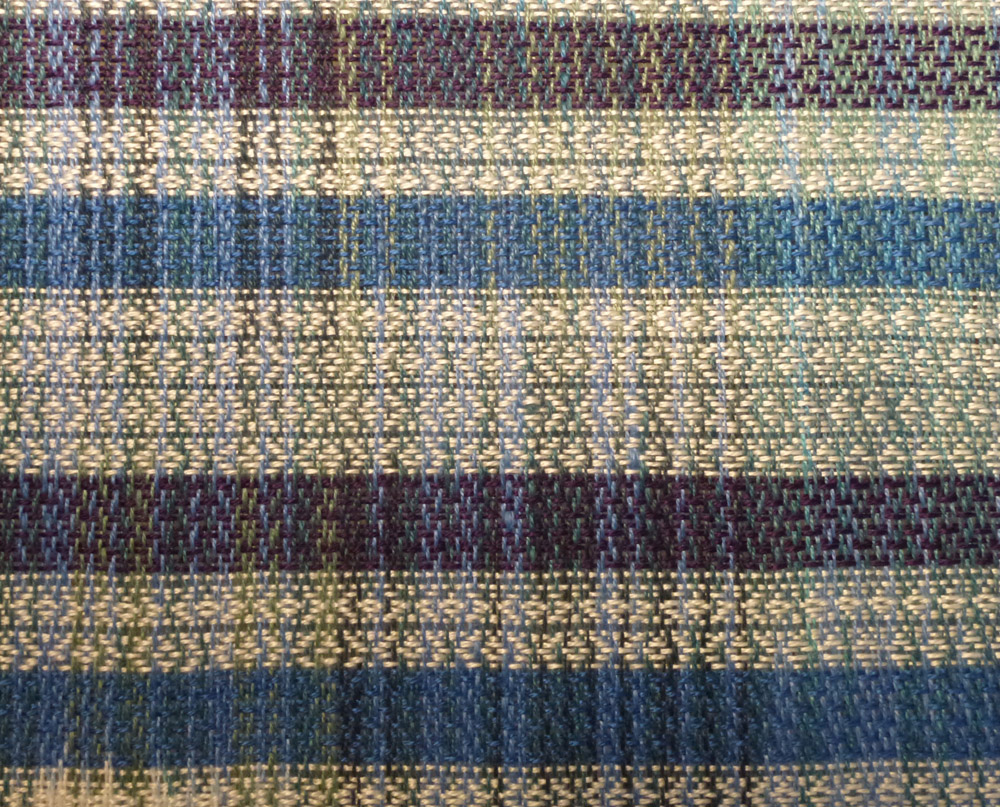
Close up of the weaving.

Winding a Warp – Towel exchange

Towels_warpHello again. It’s been a busy almost 2 years since I last posted here. In the meantime, I started an e-newsletter and have been posting on my Facebook page, so my writing efforts have been appearing in those venues. Part of the reason it’s been so long is I ran into the proverbial writers block in my art story. Time to start on a different theme.
This coming September I will start teaching weaving at the Swedish Club in Seattle. I have been thinking about doing a series of posts on fiber processes so I decided to start with a few on weaving. These posts can be an introduction and a resource for my students.

The other kick in the rear I got is recently my husband’s cousin told me she has plans to start a sewing blog. We challenged each other to post something before our next family gathering in mid September. So here we go.

A couple of years ago I participated in a handwoven towel exchange project through the Seattle Weavers’ Guild. Having had the idea of writing a series of ‘how to’ posts, I’ve occasionally been taking process pictures of the projects I’m working on. The series of photos from this project includes most of the steps for setting up a loom.

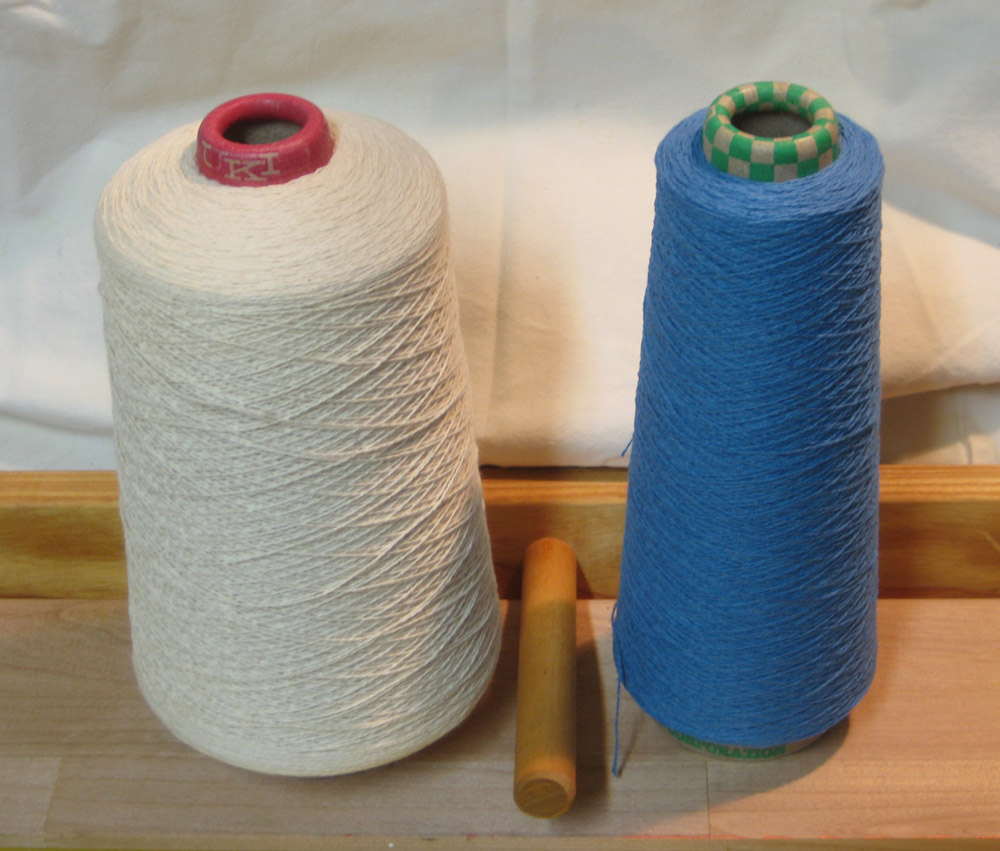
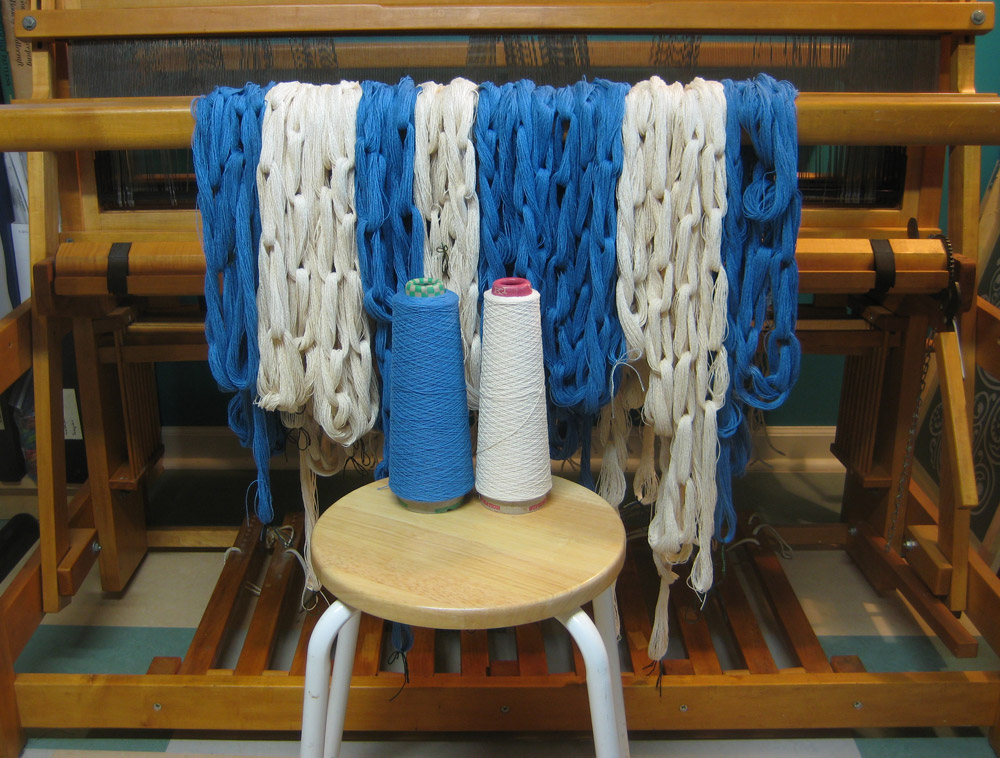
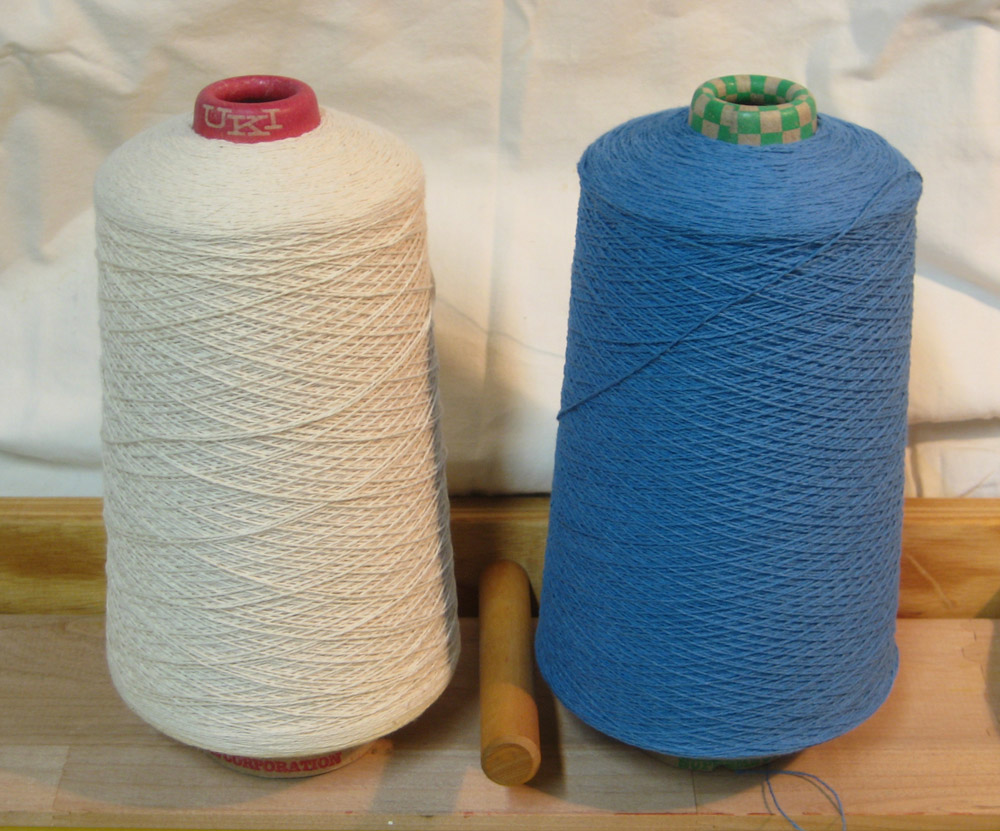
I started with these 2 cones of 8/2 matte cotton yarn.

I started with these 2 cones of 8/2 matte cotton yarn.

So what is a towel exchange? Each participant wove a number of towels and brought the finished towels to a meeting. We drew numbers and took turns picking out other weaver’s towels. We all went home with the same number of towels, just they were ones woven by someone else.

Setting up a loom – Step #1 – Winding the warp

The warp are the lengthwise yarns that are under tension on the loom. After you decide the size of the finished cloth, you calculate the number of warp threads (or ends) and the length you’ll need. This project needed a total of 480 ends, each 12 yards long for a total of 5,760 yards. Which for this yarn was about 1.7 pounds.

Towels_warping_board

Warping Board

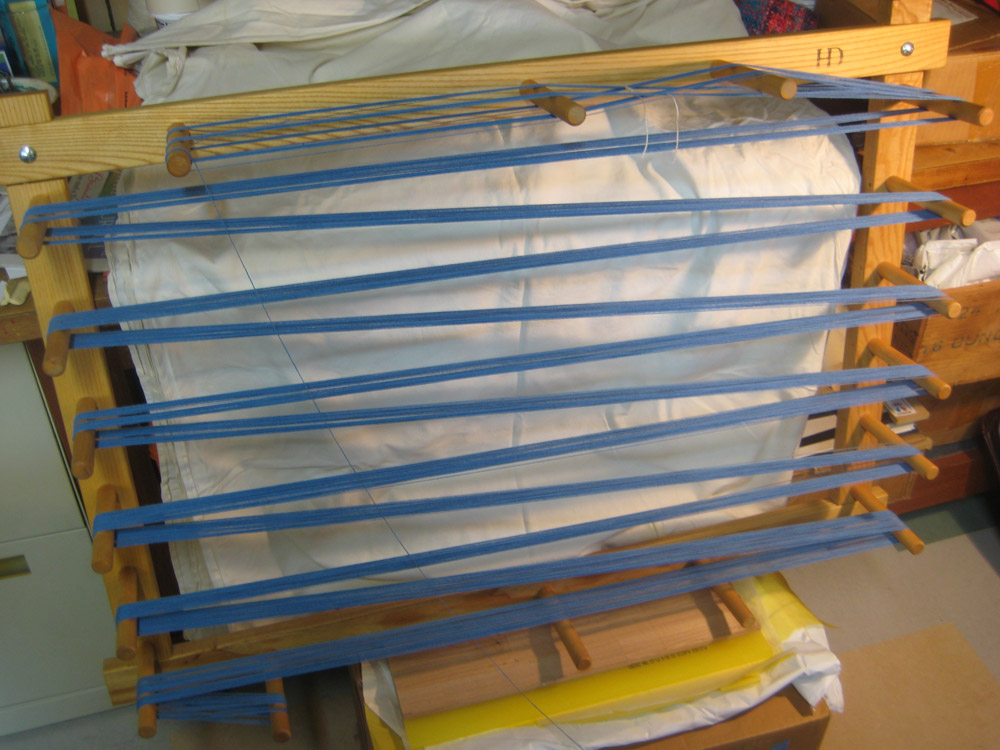
In the photo above and the video below, you see the threads being wound on a warping board. The pegs are 1 yard apart making it easy to get the length you need. Towels_warp_cross

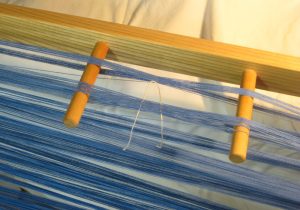
At the top are two extra pegs that allow you to form a figure ‘8’ called a ‘cross’. A yarn is tied through the spaces to maintain the ‘cross’ which helps to keep the threads in order while putting them on the loom.

Towels_partial_blue_cone

The blue warp threads have all been measured and cut but none of the white warp has been wound yet. Used over half of the cone.

After you finish winding a section of the warp, in this case 2″ worth, you need to chain the warp bundle. It’s done the same way you make a chain in crochet, just using your hands. Start at the end away from the cross and continue until you have “chained” the warp to the tie for the cross. This will keep the warp threads from getting totally tangled up.

Towels_warp_chains

The warp is chained and now ready to be put onto the loom. Note how much yarn is left on the cones.

So if you are inspired to learn how to weave, my beginning weaving class starts Tues. Sept. 13th and meets from 6:30 to 8:30 pm. The registration form is available HERE.

Next post will be about threading the loom.


“Pulling Spirit into Daily Life”

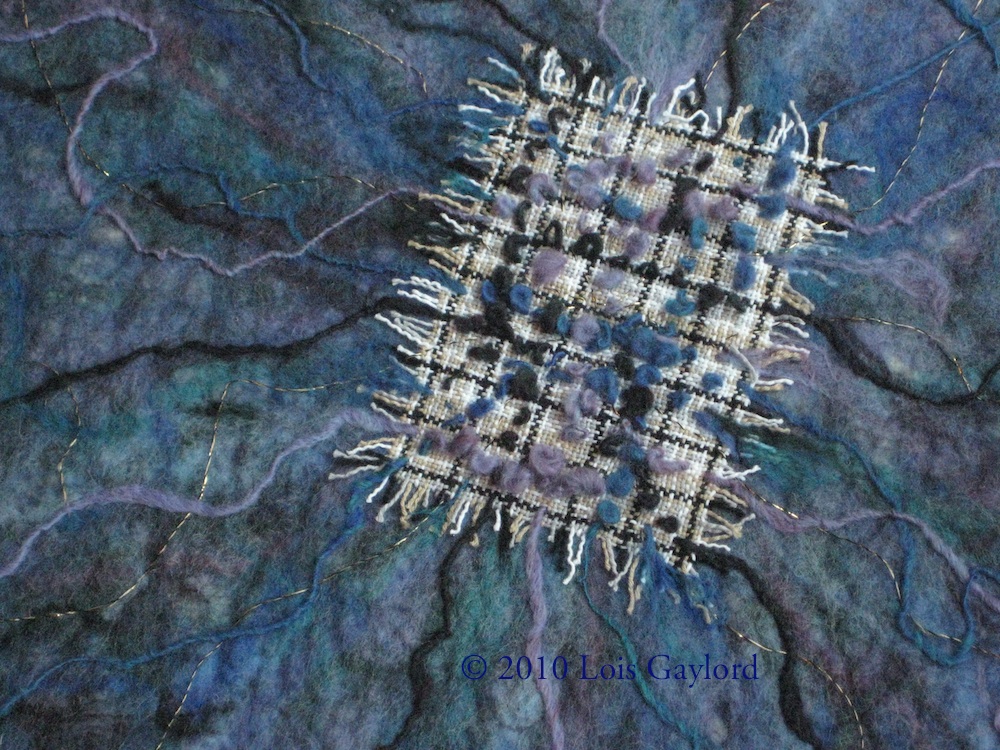
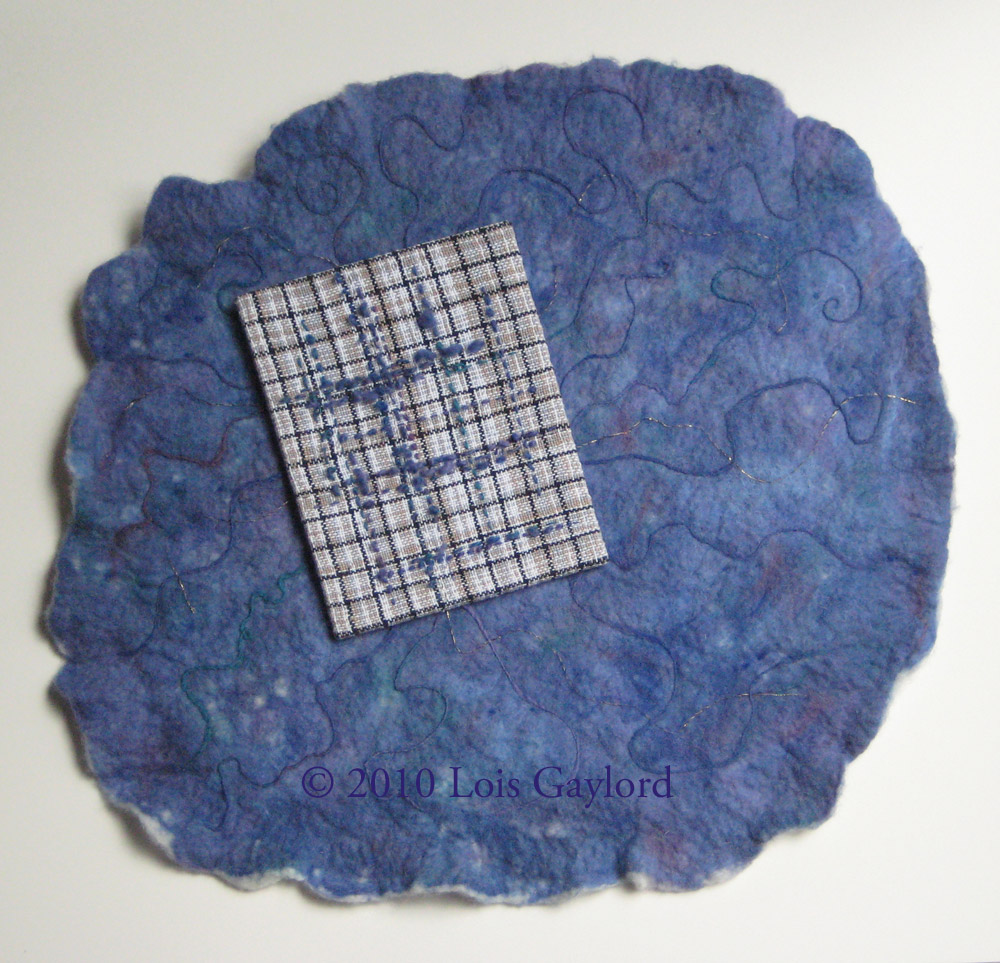
It was the third and last quarter of the certificate program, and time to start on our final piece that would be in our class show. After the harsh critique of my last piece, I wanted to ‘redeem myself’ and make a better one. Rather than starting with a new concept, I decided to continue working with the same subject. The second result was way more successful in expressing the ideas I had. During my meditations prior to the first piece (along with the words “pulling the threads of spirit into our daily lives”) I saw the juxtaposition of two different types of textiles connected with threads or yarn. The felt would represent the spirit world that is often only sensed with an intuitive feeling. The woven piece, with it’s gridded pattern, would illustrate the regulated structures of daily life and the human penchant for categorizing and labeling everything. Adding the connecting threads would open the possibility to begin merging the two worlds.
Pulling Spirit detail 2smOne of my goals for the certificate program was to find a focus for my work. While working on this piece I realized that I had found it. A lot of artists focus on a specific technique and/or subject matter. For me it’s the concept and ideas behind the piece not the technique that is my focus. And overall, it is the Spiritual aspect that has become the primary focus for my work.
This piece is the second in what will eventually be a triptych. The third piece will be “The Spiritual Life”. Looking back, these pieces were representative of my own journey. I needed to make “…Awakening to Spirit” first, as it reflected my past. When I made “Pulling Spirit…” it showed where I was on my path at that time. I started to prep the fleece for the base of the third piece, but that’s as far as I’ve gotten on it. The compelling need to work on it again hasn’t happened yet. I’m still pulling those threads of Spirit into my daily life. When it’s time, I’ll make that third piece.

“Daily Life Awakening to Spirit”

It was the beginning of March 2010 and the end of the second quarter of the certificate program. The major focus for the quarter was “Conceptual Strategies in Fiber Art” and looking at the creative process in general, and our own process in particular. Towards the end of the quarter, we were to reflect on an old piece, and use it as a springboard for a new piece, our final piece for the quarter. Since I couldn’t decide which piece to reflect on, I looked at two pieces, “Shamanic Connections” and “Finding the Patterns in the Puzzle of Life”. Working from those pieces and another idea that I got during meditation, I started on my piece “Pulling the Threads of Spirit into our Daily Lives”. I finished the piece the night before class, mounted it the next morning, wrote the reflection on it in the afternoon, and headed to class that evening.

For those of you reading this that have taken art classes, and have turned in work for critiques, you know what a challenging experience they can sometimes be. I had one of “those” critiques that night. In class we were asked to say whatever we wanted to about the work. I felt unprepared, and unsure of what to say. I started rambling on about unimportant details, because I couldn’t bring myself to talk about my personal angst issues which was what I had been thinking and writing about in my original reflection.

This is part of what I wrote:    “The experience of doing this piece was both fun and challenging. The fun part was doing the work. When focusing on the tasks at hand, I would lose track of time and get absorbed in the processes. The challenging part was mostly on a personal and emotional level. This program has been helping me deal with all the issues that stopped me making art 20 + years ago. Working on this piece brought up the issues I have with the fundamental value of doing this type of work. The questions of; is it worth doing, is it a waste of time/money, etc. are staring me in the face. Making this piece, or any finished work, brings these issues to the surface where I have to deal with them. I have pushed myself out of my comfort zone.”

Back to the critique that night, the one positive comment I remember is someone liked the fact that I used a rectangle instead of a square which had been part of my original design. The one that really got to me was the instructors question and comment: “Is that blue blobby thing supposed to represent spirit?” to which I said yes, and he replied “It’s not really working for me”. Right… now what.Daily Life Awakening to Spirt

So that night after class I stayed up very late, and thought a lot more about the piece. So once I had gotten done “wallowing in my emotional stuff”, I was able to look at and think about the work itself. I liked the piece and it felt right when I was done, but there was something bugging me about it as well and I was unsure what it was. The piece didn’t say what I had intended, so in that sense it didn’t work.

Visually, the woven part looked “plopped” down, and didn’t relate to the background. The felt background is very subtle and indistinct. Was it too plain? There wasn’t enough connection between the hand-spun yarn in the woven part and the felt background. The woven portion dominated the piece visually while being smaller than the background. It felt uncomfortable, tentative and unresolved. It was very unbalanced.

Then I asked myself what did this piece have to say, and this is what I came up with along with a new name for it:

“Daily Life Awakening to Spirit”
Dominating the piece is the woven portion representing daily life. It floats above the surface, removed and separate from the spirit world. The felt background resembles how spirit is viewed from this perspective. It is very hazy and indistinct. It’s unknown, you can only see things in that world if you look closely at it. The hand-spun yarn becomes spirit beginning to weave itself into our daily life but only in places, a bit at a time. The piece feels disjointed and unbalanced because this can be a very disconcerting state. You know that something is not right, that things are changing, shifting, but what and how is not known. It requires an enormous amount of trust to reside in this place and even more to continue on the journey to discover and embrace Spirit.

The following were my final thoughts about this piece and the experience of making it:
“Working on something this nebulous and intuitive requires an enormous amount of trust. I know that I’m not entirely in control of the process, and the work (or any given piece) can seem to take on “a life of it’s own”. This piece seems to have it’s own message and said what it needed to say. I need to pay better attention. So, hopefully I’m back on a productive path, doing something worthwhile.

The next quarter I did a second piece, the one I had intended to make, “Pulling Spirit into Daily Life”, which will be the next post in my Art Story.